Our 2025 Efforts to Design User-Focused Products
Hello, I'm Moriya (emim) from the Engineering Office.
This article is part of KINTO Technologies Advent Calendar 2025 for Day 11.
On Day 2 of the event, I posted an article about accessibility, while my primary job is product design. As a core function, I work as a designer within the Engineering Office, analyzing the situation at KINTO Technologies (KTC) and implementing initiatives to strengthen organizational capabilities.
At KTC, our Executive Vice President Kageyama announced the following four key ideas which we focus on in 2025: AI first and release first that are directly related to our product development, as well as user first and organizational intensity to fundamentally support the former two ideas.
As a designer, I am involved in promoting user-first design among these ideas. Looking back to June 2025 when I joined KTC, user-focused activities have been already underway within the organization in various aspects since the beginning of 2025.
As a year-end summary for 2025, I will wrap up what we have accomplished.
##First Internal Survey Revealed Inconsistent Perception of Users Within KTC
Our first activity to promote user-first design was a survey to assess internal perception of users.
There are so many different types of users that we need to ensure that our members share a common understanding of them. The survey was designed to plan specific methods to promote user-first design through confirming whether everyone has the same understanding of "users."
We gathered members from various divisions and roles across the company and conducted group discussions to understand the current circumstances. Group-work sessions were held in various formats, including brainstorming with online whiteboard tools and on-site workshops to map the user perception with sticky notes.
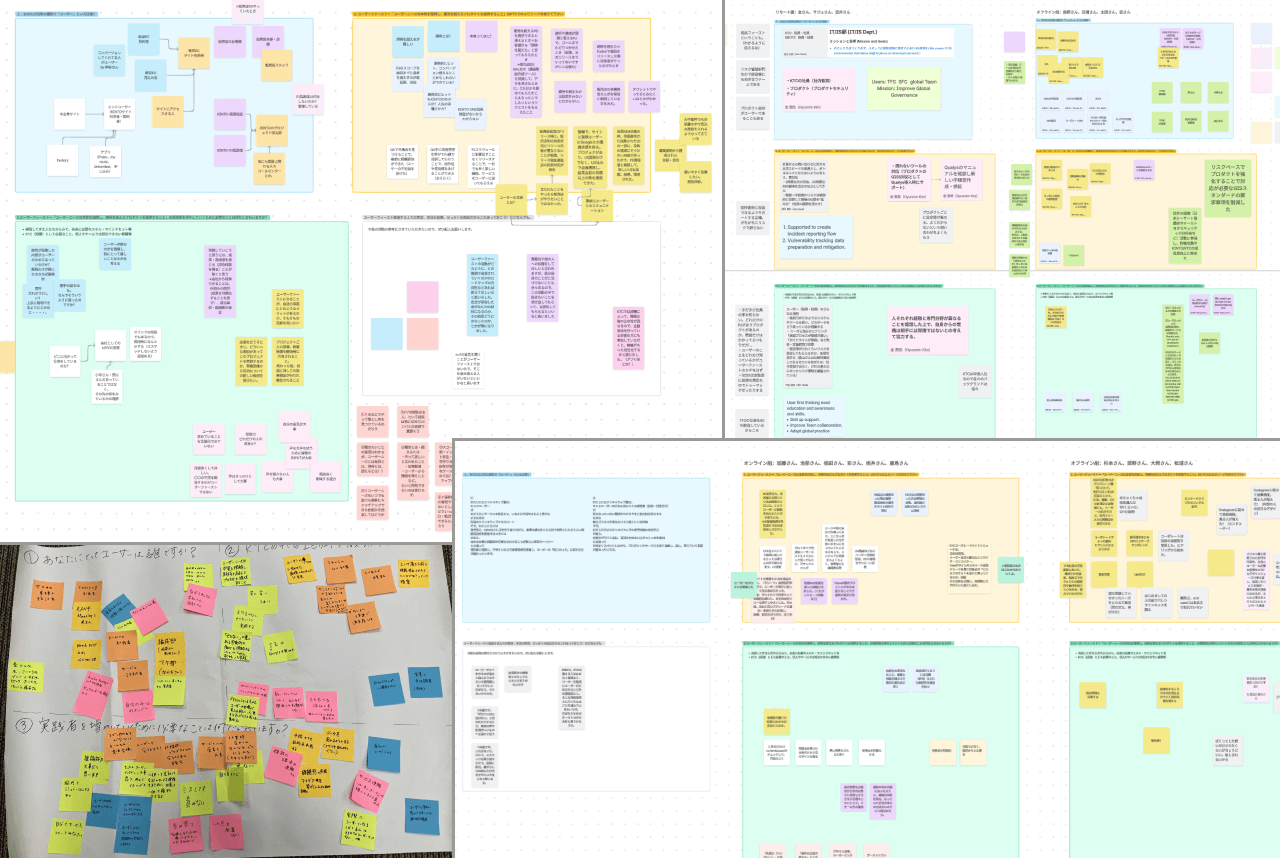
I joined my current team after completing the survey, and we then organized the relationship between users at each level—from business model stakeholders to end users—and products, in a format similar to Jeff Patton's onion model.
Through this process, we found a considerable gap between our products and users’ needs. Perhaps due to the gap or complexity of our businesses, some people seemed to perceive stakeholders (such as colleagues in different roles with hierarchical relationships, partners at related/group companies, or clients) as users.
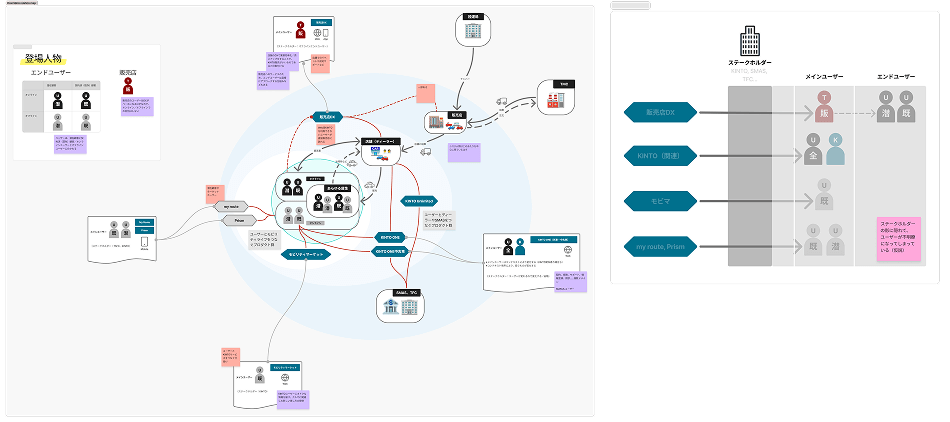
While the user-first design is raised as a discussion topic from the concern that we cannot see what users want, we found that our development organization structure is one of the factors contributing to addressing this. When developers are distant from our users, the next step will be how to involve stakeholders, raise their awareness, and draw out users’ needs.
We also shared the information with our Executive Vice President, who is responsible for this initiative, confirming alignment for seamless activity promotion.
Current Statement Analysis Using Level of UX Maturity and Next Step of Sharing
With organizational challenges clarified, we focused on two points:
- Raising developers’ awareness of the term user to remind them of a user-first mindset
- Involving members to understand users
The former may seem obvious for product/service development, but not all developers sufficiently consider users yet.
To measure our developers’ perception on users, we conducted a current state analysis referencing The 6 Levels of UX Maturity. This document includes a quiz in the latter half that allows individuals to self-assess their organizational conditions.
Based on the content and quiz results, we are still at Stage 2: Limited. Clarifying our current position enables us to identify what we must do to advance to Stage 3: Emergent, the next level.
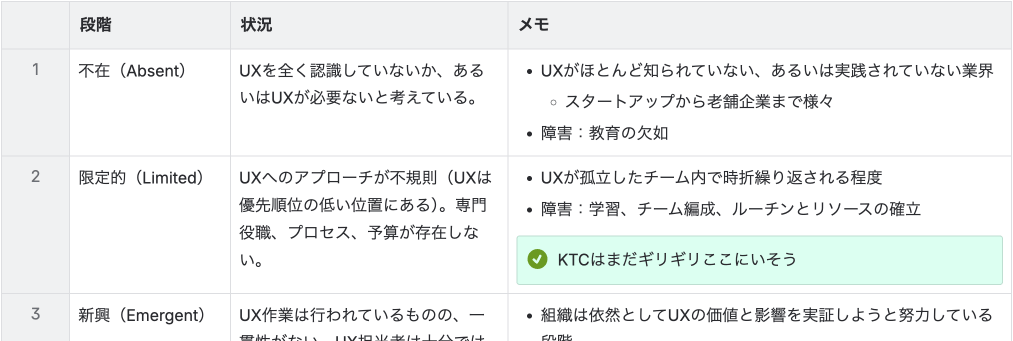
Fortunately, we do not face the issue common in typical organizations: lack of the company’s understanding (no budget allocation). With problems identified through the top-down process, we find them easier to take action.
For organizational information sharing, regular meetings are scheduled to share information with other key topics. This enables relationships where, for example, we receive user-related consultations in release contexts, and we can also had discussions about AI utilization for future initiatives.
However, this alone limits information sharing to a specific scope. Therefore, we next conducted a company-wide information sharing session.
Initiatives to Prevent UX from Being Isolated
Sharing Our Promotion Activities
The first step was reporting activities at the monthly company-wide information sharing session.
We reconfirmed our current position, which we previously agreed upon with various parties, and mainly presented how developers can put a focus on user value.
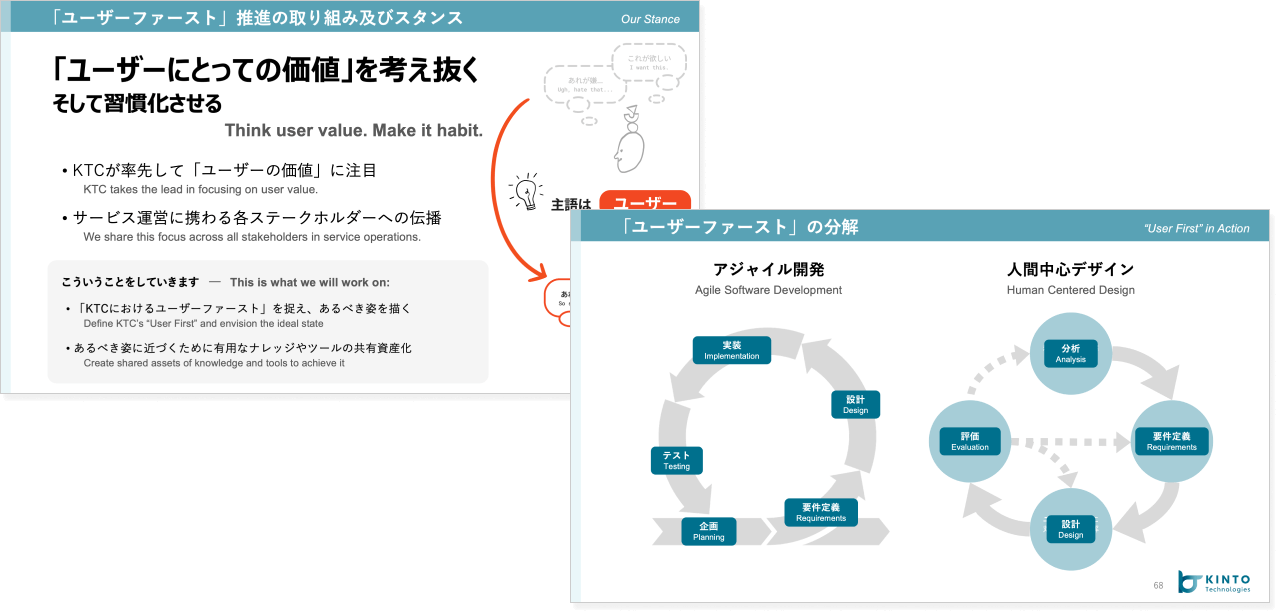
We explained development methods focusing on user value, citing similarities between agile development and human-centered design (HCD).
Even engineers familiar with agile diagrams reacted as if they heard about HCD for the first time. Through the presentation that specific methods are provided for each HCD process, this single presentation created a situation where engineers could easily have discussions on specific topics.
Exploring Internal Case Studies (Conducting Study Sessions)
Next, we organized study sessions to spotlight those who have been working on running the HCD process before and share their activities on a company-wide basis. Through these sessions, we aimed to give rise to participants’ expectation that they could do it too.
In these sessions, we had presenters share examples of implementing specific HCD processes within projects and cases where they attended events hosted by our sister company KINTO to understand how users use our services.
Regarding the latter, one of the session attendees previously wrote an article on the following blog.
Furthermore, considering our company's large engineering population, we invited our frontend engineers who implemented the aforementioned initiatives and backend engineers whom we had interviews with to share detailed changes in their mindset through their efforts during the panel discussions in the session.
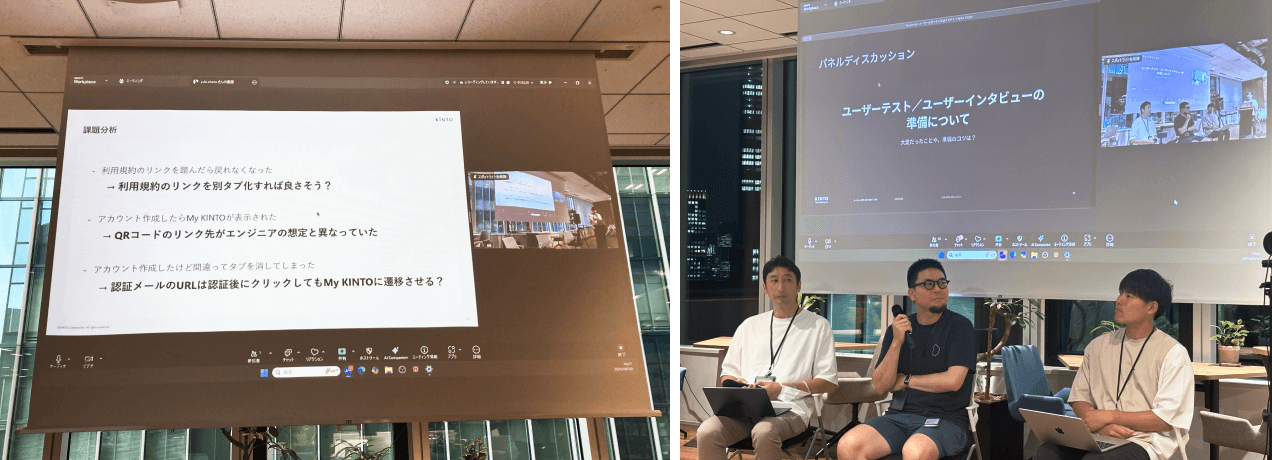
After this study session, we witnessed changes in members’ behavior; for example, they contacted us about specific methods for deeply understanding user needs that include user interviews and customer journey maps. Recently, we received requests for consultations from engineers at a pace of about one every two weeks.
Our Future Activities
Currently, this initiative is carried out by myself and one of my colleagues Okane-san from the Creative Group. We have roughly divided our roles: I, Moriya, handle internal promotion of user-first activities and standardization/horizontal deployment of various processes, while Okane-san joins projects to execute HCD processes. Of course, we are short-handed, though.
As mentioned earlier, we believe the most important thing is to increase the number if colleagues who can execute the processes, reach out to people in related areas for cooperation, and keep this activity going. Additionally, by presenting these activities again, we can spotlight activities that no longer gain traction in various areas once again to learn and leverage them as knowledge.
As introduced at the beginning, while this is one of 2025's focus points, thinking about users is the foundation of product design. To keep proceeding with this initiative in a sustainable manner, we plan to continue refining our efforts beyond next year.
Finally, on December 23, Okane-san, who works with me on this initiative, will publish an article about her own challenges in the KINTO Technologies Advent Calendar 2025. Stay tuned!

関連記事 | Related Posts
We are hiring!
リードエンジニア/プロジェクト推進G/東京・名古屋
業務内容バックエンド開発を中心に、サービスの企画から設計・開発・運用までプロダクトに関わっていただきます。サービスや会社の成長を考えて、自分やチームが何をすべきか自律的に動き、スピード感を持って開発に取り組むことを期待しています。
【UI/UXデザイナー】クリエイティブ室/東京・大阪・福岡
クリエイティブGについてKINTOやトヨタが抱えている課題やサービスの状況に応じて、色々なプロジェクトが発生しそれにクリエイティブ力で応えるグループです。所属しているメンバーはそれぞれ異なる技術や経験を持っているので、クリエイティブの側面からサービスの改善案を出し、周りを巻き込みながらプロジェクトを進めています。