Speaker, Booth Staff, and Attendee: Reflecting on CloudNative Days 2025 Winter
This article is Day 10 of the KINTO Technologies Advent Calendar 2025 🎅🎄
Introduction
I'm Liu (YOU), an Infrastructure Architect in the Cloud Infrastructure Group (CIG) at KINTO Technologies. Starting in November, I've also taken on responsibilities in the Developer Relations Group.
In November 2025, our company participated in "CloudNative Days 2025 Winter" as a sponsor. At this event, two of our colleagues gave presentations, the Cloud Infrastructure Group and the Developer Relations Group that I belong to operated the sponsor booth, and many members attended technical sessions, allowing the entire organization to be actively involved.
CloudNative Days is the largest event in Japan's cloud-native community. Through this participation, we not only deepened our technical knowledge but also had the opportunity to reconsider the very concept of cloud-native itself.
In this article, I'll share the event experience and learnings from the perspectives of speakers, booth operators, and general attendees.
Speaker Interviews
Koshiro from Cloud Infrastructure Group: "Building the Cloud Foundation for the Future of Mobility Platforms"

How I Came to Speak
- Koshiro: "Having been with the company for less than a year, I didn't know the organization's history or the reasons behind our technology choices. Conveying things I hadn't experienced firsthand was the biggest challenge."
Originally, another member was scheduled to speak, but circumstances led to him stepping in at short notice. Having joined in January 2025, this was a challenge for him without fully understanding the organization's history or the background of our technology decisions.
Background on Topic Selection
He struggled with cloud‑native as a topic. Looking into available resources, he found that many talks went deep into Kubernetes and container technologies. Since our company mainly uses ECS and only uses Kubernetes in limited areas, he couldn’t fully relate. Eventually, he realized that this struggle itself was worth sharing with others who are in the same situation.
- Koshiro: "Cloud‑native may feel like a high‑level concept and getting there requires organizational trial and error. Technical excellence is important but building a cloud‑native culture within the organization is more important. There is no single best practice."
What I most wanted to convey was that cloud-native is a means, not an end. We select appropriate technologies while facing our business needs. By sharing our history of trial and error as it really happened, I hoped to give others facing similar challenges a chance to move forward.
Audience Reactions on the Day
Venue C, with a capacity of 66 people, was nearly full. Many attendees who had been watching other sessions online moved to this session midway through.
- Koshiro: "There were people nodding along as they listened, and some took photos of my slides to post on X. At an event where technology seems heavily emphasized, it was striking to see people show interest in my topic."
Two people asked questions at the microphone, and three visited "Ask the Speaker," giving me a strong sense of accomplishment for my first presentation. What stayed with me most were the questions about Terraform structure and the platform organization's decision-making. These are questions without definitive answers and I was reminded that everyone struggles with these things.
Lessons Learned
This was a substantial 40-minute presentation, and through the intensive preparation and practice, Koshiro-san realized how important regular output truly is.
- Koshiro: "I realized that if I had been giving a presentation regularly, creating slides would have been much easier. If I'd been writing tech blogs, I could have adapted and utilized that content. I've resolved to work harder on my output."
He also gained an important insight about using AI. From his initial failed attempt to create a talk script with AI, he learned this lesson: "First establish what message you want to convey, then ask AI how to express it. Never start by asking AI. It's a recipe for failure."
Looking Ahead
For next time, he wants to build experience with shorter 20-minute presentations and also challenge himself to present more technology-focused topics. Additionally, since it's a community event, he expressed a desire to deepen connections with participants through group work and mutual learning.
- Koshiro: "Next year, we'll be hosting a cloud-native conference. KINTO Technologies is one of the most advanced organizations within the Toyota Group when it comes to cloud adoption. While we don't have everything figured out yet, we've reached a stage where we can build high-level solutions together. I'd be happy to see more opportunities for collaboration and study sessions."
Lee-san from Platform G: "A New Era of Alert Response Pioneered by AI Agents"

The Decision to Submit Proposal to CFP
Lee-san submitted a proposal to CFP with a "let's just try" attitude, thinking the chances of acceptance were low. The reasons for applying were clear: to enhance the company's external communication power, contribute to engineer recruitment within the group, and gain opportunities for external communication. Since the submission was completely separate from sponsor work, being accepted came as a surprise.
Struggles with Material Preparation
He struggled most with determining the right skill level for the audience when creating the materials.
- Lee: "With both experts and beginners in the audience, I struggled to decide what level to aim for. I wanted the content to be easy to understand even for those unfamiliar with the topic, but if I made it too light, it wouldn’t satisfy people looking for deeper knowledge. Striking that balance was the hardest part."
I particularly focused on storytelling. I was conscious of the flow: "there was this challenge → we responded this way → the result was this → now we're at this point," and reviewed the overall structure multiple times to make the narrative flow naturally. Material preparation took over a week, continuously improving the script and presentation.
Unexpected Events
On the day, his biggest concern was whether PowerPoint's script feature would be visible on the audience's screen. For a 40-minute presentation, going without notes would be tough, so during lunch he went to the venue myself to ask for a quick run‑through.
- Lee: "They provided basic information for speakers, such as arrival times and HDMI connection details, but there should have been more guidance on things like rehearsals and checking script display. For our members who present at future events, I’d recommend visiting the venue in advance to confirm these details themselves."
Audience Response
The presentation was well-received overall, with fellow speaker Koshiro-san commenting that it was "the most impressive session of the day." After the presentation, 4-5 people came with questions, and Lee-san said he could feel the high interest in AI Agents.
What stood out to him most was a question about context engineering: How do you distinguish between information needed for AI and information needed only by humans but not by AI? He shared the countermeasures currently under consideration for this question as well.
- Lee: "There's the issue of LLM model input limitations, and if the context gets too large, it exceeds the limits. We plan to address this with a single-agent configuration, verifying a method to summarize and compress history using LangChain's new features. I want to talk about these improvements at next year's conferences or in technical articles."
Lessons Learned
For him, this was the first time speaking at a large-scale open community event, so there was a lot to gain.
- Lee: "I was nervous, but I found that there was no need to be as scared as I was. If there are people who want to try, I recommend giving it a shot. I was greatly inspired from other speakers and participants, and my technical motivation increased."
In terms of technical takeaways, he found the presentations on incident‑management SaaS and CyberAgent’s Ōyama-san’s talk on Loki and Prometheus particularly insightful. He also gained a few dozen new followers on X, which helped broaden his connections within the community.
Looking Ahead
There are areas for improvement regarding time management. When he practiced his presentation, he noticed that he finished earlier than expected. However, during the actual presentation, he got nervous and couldn’t get the words out. He ended up running short on time and had to skip a page.
Next time, he is thinking of giving a talk on improving context engineering and methods for evaluating agents.
- Lee: "It’s difficult to evaluate the effectiveness of an agent because creating proper evaluation criteria is challenging. Even when alerts seem to be the same, the underlying causes can differ, which makes it hard to build accurate ground‑truth data. This is widely recognized as a common issue across the industry. Context engineering is a field that has recently been gaining attention, but best practices have yet to be established. I believe this is a topic many people are eager to learn about."
His advice is clear.
- Lee: "What matters most is simply applying. Once you get accepted, your future self will figure it out. It boosts your motivation and inspiration, and it also helps raise your company’s presence, benefiting both sides."
Other Speakers
Tsuji-san, the Manager of Cloud Infrastructure Group, also gave a talk about the Toyota Group's technical community!
Tsuji-san from Cloud Infrastructure Group: "Introducing TURTLE, the Toyota Group Engineer Community!"

Booth Operation Interview
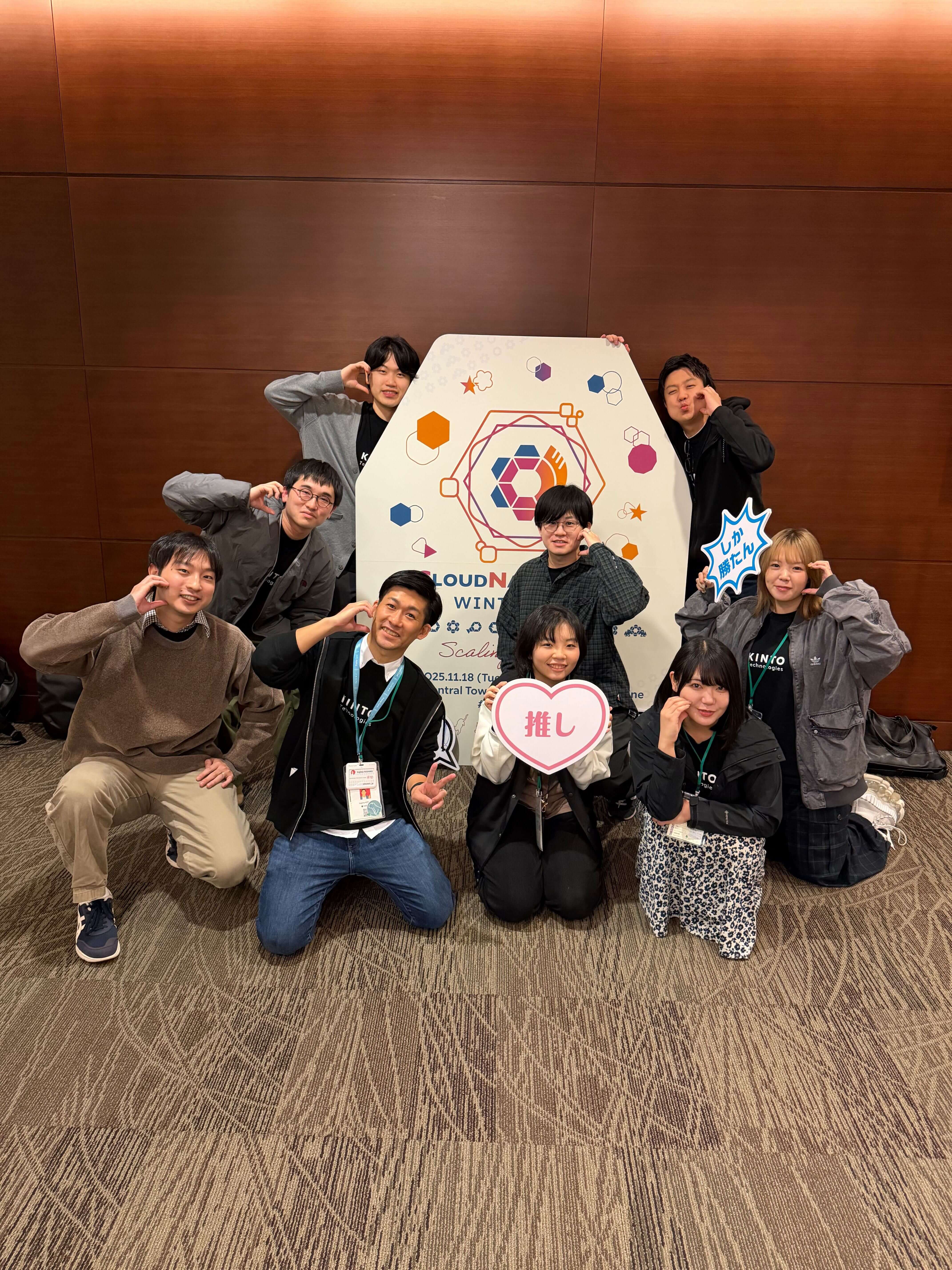
Many people from our company helped with this booth operation. With cooperation from various groups including Cloud Infrastructure Group, Platform Group, HR Group, and Developer Relations Group, we were able to run an exciting booth operation and complete it successfully.
For the booth operation interview, we proceeded in a discussion format, with participation from:
- Cloud Infrastructure Group (CIG): Koshiro, Shirai, Yasuda, Matsuo
- Developer Relations Group: Murayama
Challenges in the Preparation Stage
This was CIG's first time operating a booth, so we didn't know what to do, but our company has the Developer Relations Group that fully supports events like this from planning to reflection, enhancing both internal and external communication power.
This time too, Murayama-san from the Developer Relations Group provided support from the booth preparation stage. Her collaboration with Manager Tsuji-san was a key factor in successfully running the booth.
-
Murayama: "I consulted with Manager Tsuji-san in advance and briefly communicated what information we wanted. Things progressed through CIG's regular meetings, and before I knew it, the shift schedule was ready, which was very helpful."
-
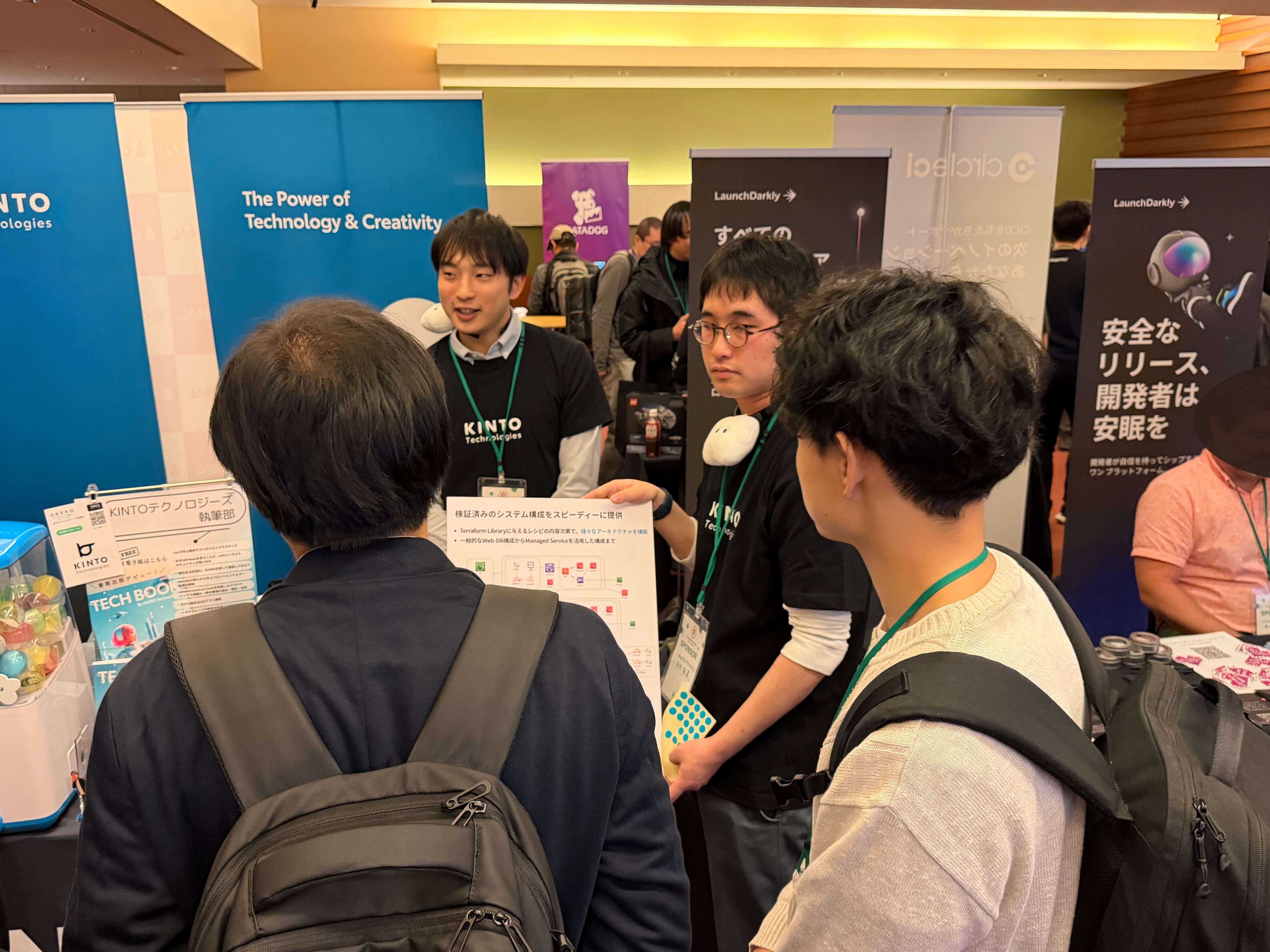
Murayama: "Also, at a conference we sponsored over the weekend before the event, we displayed a board featuring our system architecture diagram, which was very well received and helped us have many conversations with attendees. So, even though it was the day before the event, I suggested, "Do you have any architecture diagrams we could display?" and they immediately provided the perfect architecture diagram. We barely made it in time for printing, but we managed to have it at our booth. Since it served as a great conversation starter, I'm really glad we were able to prepare it!"
I felt the advice was truly valuable, because understanding what attracts people to a booth is something you can’t really grasp without having run many booths yourself.

For Cloud Infrastructure Group, many people participated in booth operation for the first time, so most of it was about preparing ourselves to get into the right mindset.
- Shirai: "I made a conscious effort to stay cheerful and energetic so as not to give off any negative impression. I wanted visitors to have a good impression of our booth."
As Shirai-san said, we put a lot of effort into presenting a positive attitude to the people who visited our booth.
Observations and Insights on the Day
Cloud Infrastructure Group had two main points they wanted to convey at CloudNative Days 2025 Winter. According to Koshiro-san, who spoke at the sponsor session:
- Koshiro: "First, we wanted people to know what the Cloud Infrastructure Group[1] does. Second, it was about publicizing the activities of the Solutions Team within our group. Our company does various activities not only for our own services but for the entire Toyota Group. We wanted visitors to know a little about it."
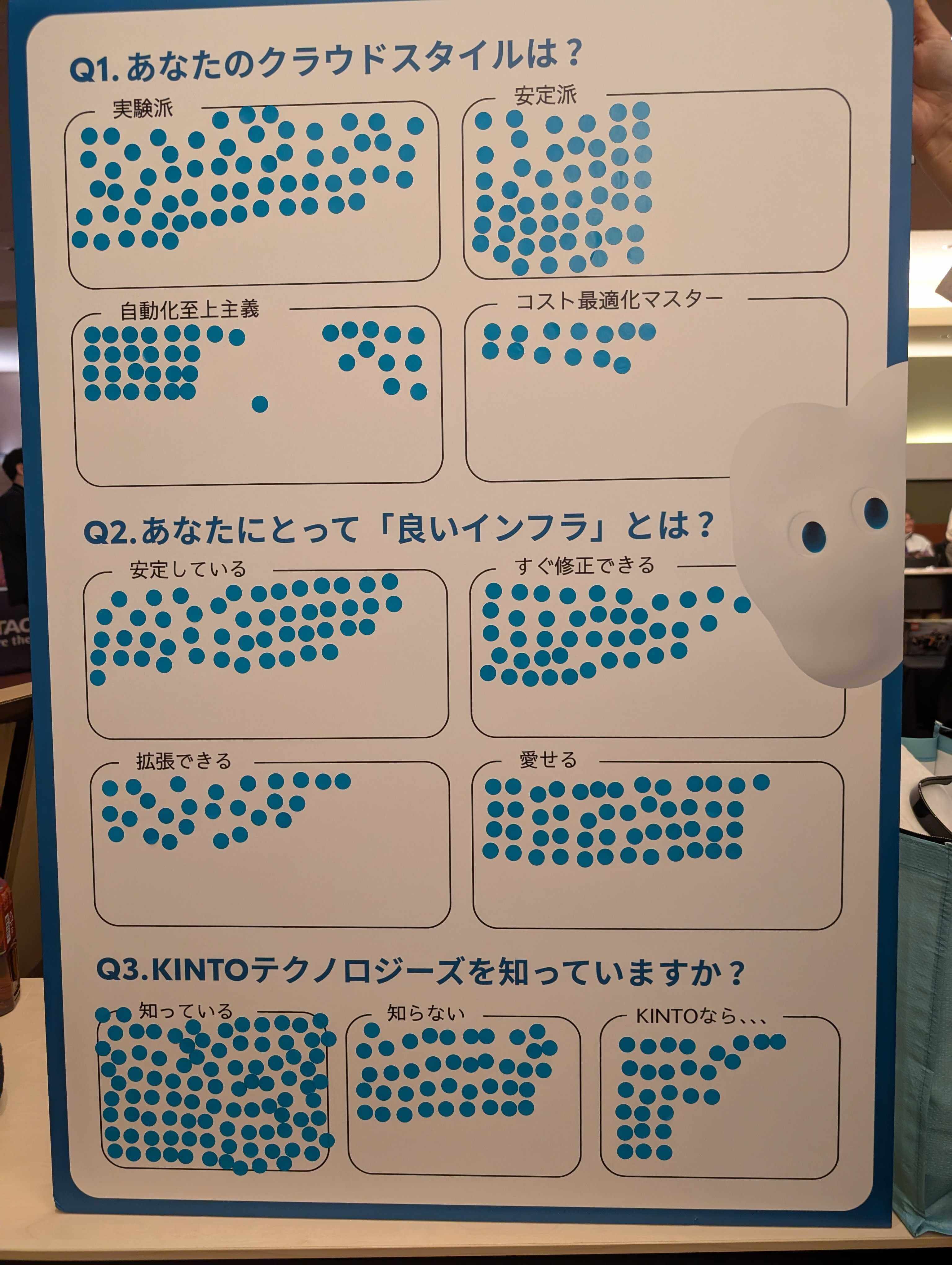
Specifically, we communicated with visitors through the question board prepared at the booth:
- Q3. Do you know KINTO Technologies?
Through this question, we were able to broadly communicate our activities as Cloud Infrastructure Group and the company's direction while engaging in conversation.
There were also other important insights:
- Koshiro: "Not all event participants come to the booth, but those who do come and listen are at least interested in KINTO Technologies. Also, I noticed that a certain number of people aren't involved in cloud-native itself. This gap between the event title and the actual attendees stood out to me."
Initially, we had the impression that many cloud-native engineers would participate since it was a cloud-native event, but we found that there were more people who want to pursue cloud-native in the future than engineers already doing cloud-native work. In fact, the venue had people from various backgrounds, including app developers, sales representatives, designers, reporters, and students.
- Yasuda: "I wanted more people to know about KINTO Technologies, but half of the visitors already knew about our company. It was amazing that many people knew about KINTO Technologies from recent events like the Developer Productivity Conference and Gijutsushoten."
We also found that CloudNativeDays participants include very few infrastructure specialists. Many people said that app developers often also handle infrastructure responsibilities, and it's very challenging to write application code while also creating infrastructure resources and handling security. KINTO Technologies has dedicated infrastructure and SRE/security teams like ours, with clearly divided roles, so I strongly feel once again that we can focus on our respective areas of expertise.
There were also opinions that it was good to hear various people's perspectives through the question board. We adjusted our questions depending on visitors' backgrounds, personalities, and points of interest.
-
Q1. What's your cloud style? → Work style & Development style
-
Q2. What is "good infrastructure" to you? → "Good work" or "Good system"
-
Matsuo: "I'm glad we could go beyond the questions on the board and hear about people's perspectives and what they prioritize. What left an impression was that surprisingly many people work with cloud services other than AWS. Since I've only used AWS, it made me want to try multi-cloud."
Many people with various roles and a strong interest in technology participated:
- Shirai: "We had visitors with diverse roles, and it was difficult to have deeper conversations with people in roles outside my area of expertise. Going forward, I want to build my foundation (knowledge and communication skills) so I can talk with people in a wide range of roles."
Even for CloudNative booth operations, I feel we need to prepare a system that can handle visitors of all roles, not just infrastructure specialist positions.
Results and Improvements
As one of the biggest achievements this time, we had this conversation:
-
Koshiro: "Almost everyone in the Infrastructure Team and Kaizen Team participated in the event as our group's operators. It's quite a rare experience. I'm grateful we could share the same event experience. While running the event, we were able to share learnings with each other like 'this is how it works' or 'that's how it should be.'"
-
Shirai: "By holding an event with the whole team, the team's sense of unity increased even more. Also, by hearing about what other companies are practicing, we could gain new insights."
Participating individually in events is good, but when participating as a team, you can establish the same mindset with each other. I believe we were able to foster team growth and raise awareness, and by working together, we could once again establish a path for continuous technical outreach.
On the other hand, there were also areas for improvement. This time, we also had the purpose of listening to sessions we were interested in as participants to broaden our knowledge, so we created a shift schedule within the group in advance.
-
Matsuo: "We created a shift schedule, but when it was my turn and I headed to the booth, I was surprised that everyone was at the booth."
-
Koshiro: "Next time we run a booth, it would be better to have 3 people at the booth while others attend sessions for input. We need to think about ways to be more efficient, like finding blog topics at sessions."
What we recognized as an issue wasn't the shift problem but time efficiency. Since CIG participated as both booth operators and attendees, I think it was difficult to balance between running the booth and gaining our own takeaways by attending sessions.
Still, by reflecting properly, we managed to bring clarity to the challenges each of us had in mind. Many visitors indicated on the question board that they already knew KINTO Technologies which is a clear result of our ongoing promotional efforts and proof that events aren't just one-time things. The Cloud Infrastructure Group will keep contributing to KINTO Technologies' technical outreach, and this experience will be a key ingredient for our future endeavors.
The Essence of Cloud-native
Finally, we explored in detail the results of the question board filled out by everyone.
- Shirai: "For the question 'What is good infrastructure?', many people answered, 'Something you can be passionate about.' Exploring it further, understanding your own service to the point where you can love it might be one way to deepen the understanding of the essence of cloud native."
Koshiro-san re-emphasized the message he delivered in his talk:
- Koshiro: "No organization has cloud-native perfectly figured out from the start. There are various gradations. It's necessary to build not just the technology, but also the culture and organization. Talking with various companies at the sponsor booths, I felt this anew."
Attendee Interview
Shimamura from Platform Group
Shimamura-san planned to attend to see Lee's presentation from the same group, and also he had submitted a CFP himself. Additionally, his team had recently started working with Kubernetes and EKS, so the team's technical interest was growing.
Sessions that stood out: Nintendo's Case Study
Shimamura-san was amzaed by Nintendo's session.
- Shimamura: "It was an on-premise case study and I wanted to incorporate this culture. They run full regression tests once a day, and I was surprised they use test results for purposes other than bug reporting."
What was particularly interesting was the multi-purpose use of test results.
- Shimamura: "From a UI perspective, designers don't just look at surface-level design alone but use it as decision-making material like 'considering the build result images, this would (match the surrounding atmosphere) better.' There's a flow of events from the past, and you can tell if it's natural within that flow. They also use it for voice actor dubbing. Using automated testing not just for finding bugs, but for other purposes too. It's a culture of proactively finding and improving points across multiple fronts using test results."
And he also reflected on the differences between Nintendo's case and our company:
- Shimamura: "I felt that KINTO still lacks this culture. This mindset of making things possible, noticing issues, and fixing them doesn't come naturally to us yet. I felt it's necessary not only for improving websites that have become heavy, but also for delivering KINTO's services better."
Technical Gains
Shimamura-san shared several technical gains:
-
Realizing the cause of Alloy log double-forwarding: When we recently did blue-green deployment, I noticed something similar to what I thought was the cause of Alloy logs being double-forwarded and used it as input for investigation.
-
Docker build security: I learned there are frameworks for signatures and verification to check if built container images are contaminated with malware. Given recent circumstances, I shared this information with the security team.
-
Reconfirming RCA's advantages: While incident management SaaS solutions only apply AI to incident management processes, our company has built an end-to-end solution with RCA. This reaffirmed the advantages and benefits of RCA: that everything must be unified and handled end-to-end.
Conversely, he also shared some questions he felt about certain sessions:
- In some cases, cloud-native technology was becoming the purpose rather than a means to solve problems
- I wanted to hear case-specific stories rather than general knowledge
Looking Ahead
Shimamura-san shared improvement points and outlook for next time:
- Shimamura: "I want to register for event sessions early so I can make sure I attend the ones I’m interested in. Also, instead of keeping the information I gain to myself, I want to make it accessible to other team members. If people don’t know what happened or what examples I found, then the time I spent participating would feel wasted. I believe knowledge doesn’t mean much unless it’s shared and spread."
He also showed interest in giving a talk:
- Shimamura: "My CFP submission was rejected twice, so I definitely want to give a talk next time. However, topics are the problem. I've already talked about RCA, and culture theory at Platform Engineering Meetup. I need to find new topics."
Conclusion

Through our participation in CloudNative Days 2025 Winter, we gained many learnings and insights.
Technology and Culture as Two Wheels
Speakers Koshiro-san and Lee-san each talked about cloud-native from different approaches. Koshiro-san from the perspective of organizational culture, Lee-san from the perspective of technical practice. However, what both had in common was the message that cloud-native is a means, not an end.
Through booth operation, we reconfirmed that "no organization deploys cloud-native perfectly from the start." We need to build not just technology, but culture and organization as well.
As attendee Shimamura learned from Nintendo's case, cloud-native is a culture, not a technology. A culture of proactively finding and improving points, the idea of using test results for multiple purposes, and above all, understanding your own service to the point where you can "love" it. These might be the essence of cloud native.
Team Unity
One of the biggest achievements of attending this event was that the Infrastructure Team and Kaizen Team—almost everyone—could participate as group operators. Being able to share the same event experience and learnings together greatly increased the team's sense of unity. People from other groups also helped us, and we were able to have a very good time.
The Importance of Continuous Output
What both speakers commonly felt was the importance of daily output. Having experienced the difficulty of preparing a 40-minute presentation, they realized the need for a habit of continuous output through tech blogs and study session presentations.
Also, as Shimamura-san pointed out, it's important not to keep information gained at events to yourself, but to share it with the team and organization. We believe that spreading knowledge leads to organizational growth as a whole.
Looking Ahead
In 2026, the cloud-native conference will be held (a joint event of Platform Engineering Meetup, SRE Conference, and CloudNativeDays). We also plan to exhibit at JAWS Days.
To everyone struggling with cloud-native, here's a message from Koshiro-san:
"Don't be driven by technology. Let's work together on culture-building and organization-building, striving together for business success and achieving the mission beyond business. Cloud-native is a means, not an end."
And don't forget Lee-san's advice:
"It's important to submit an application first. Don't be afraid. Just submit papers. Once you're accepted, your future self will figure it out somehow."
We hope to apply the learnings and insights gained through this event participation to future organization-building, culture-building, and technical challenges. We look forward to growing together through continuous interaction with the community.
At the time of writing this article, Cloud Infrastructure Group consists of three teams: the Infrastructure Team, Kaizen Team, and Solutions Team. ↩︎

関連記事 | Related Posts


We are hiring!
プロジェクトマネージャー(PjM)/KINTO開発推進G/東京
KINTO開発推進グループについて◉KINTO開発部 :67名 KINTO開発推進G:8名 KINTOプロダクトマネジメントG:5名 KINTOバックエンド開発G:17名 KINTOフロントエンド開発G:21名 業務管理システム開発G :9名 KINTO中古車開発G:10名 ...
【クラウドエンジニア(クラウド活用の推進)】Cloud Infrastructure G/東京・名古屋・大阪・福岡
KINTO Tech BlogCloud InfrastructureグループについてAWSを主としたクラウドインフラの設計、構築、運用を主に担当しています。