
4 min read
Event
Recap of iOSDC Japan 2024

This summary was generated by AI. Please refer to the article for accurate details.
Read the summary
StoreKit 2 made in-app purchases simpler and more reliable. The session showed how async/await reduces code complexity, streamlines receipt validation, and lets developers test safely using sandbox, TestFlight, and StoreKitTest. One key point was that StoreKit doesn’t support cases where users pay but don’t get their items—this is a critical limitation that developers must plan around. As a result, KINTO can now build smoother, more secure in-app purchase flows with fewer bugs and better user experience. We hosted a hands-on coding challenge at our booth using real project code. Participants had to read the code and stamp question numbers on it. We gave out KINTO mascot stickers and iOS-shaped cardboard cutouts that people could decorate. Those who completed the challenge got either an eco-bag or a multi-chain. Over 100 people participated, and feedback showed strong interest in our products and clear suggestions for future features. Other booths stood out too. Sansan showed off their full tech stack, DeNA had a fun code-and-map crossword, Bitkey let users build a beacon app with real devices, and Glassfiber ran a quiz that drew many attendees. These activities proved that interactive learning works well, even for complex topics, and helped attendees connect theory with real-world use. The two most impactful presentations were on StoreKit 2 and GPS location tech. StoreKit 2’s async/await improvements cut down code length by up to 40% and made testing faster. The GPS session explained how Core Location combines GPS, Wi-Fi, and cellular signals for accurate positioning. This means smartphones can find location quickly even in weak signal areas. These insights will directly improve KINTO’s location-based features, making them faster and more reliable for users.
Introduction
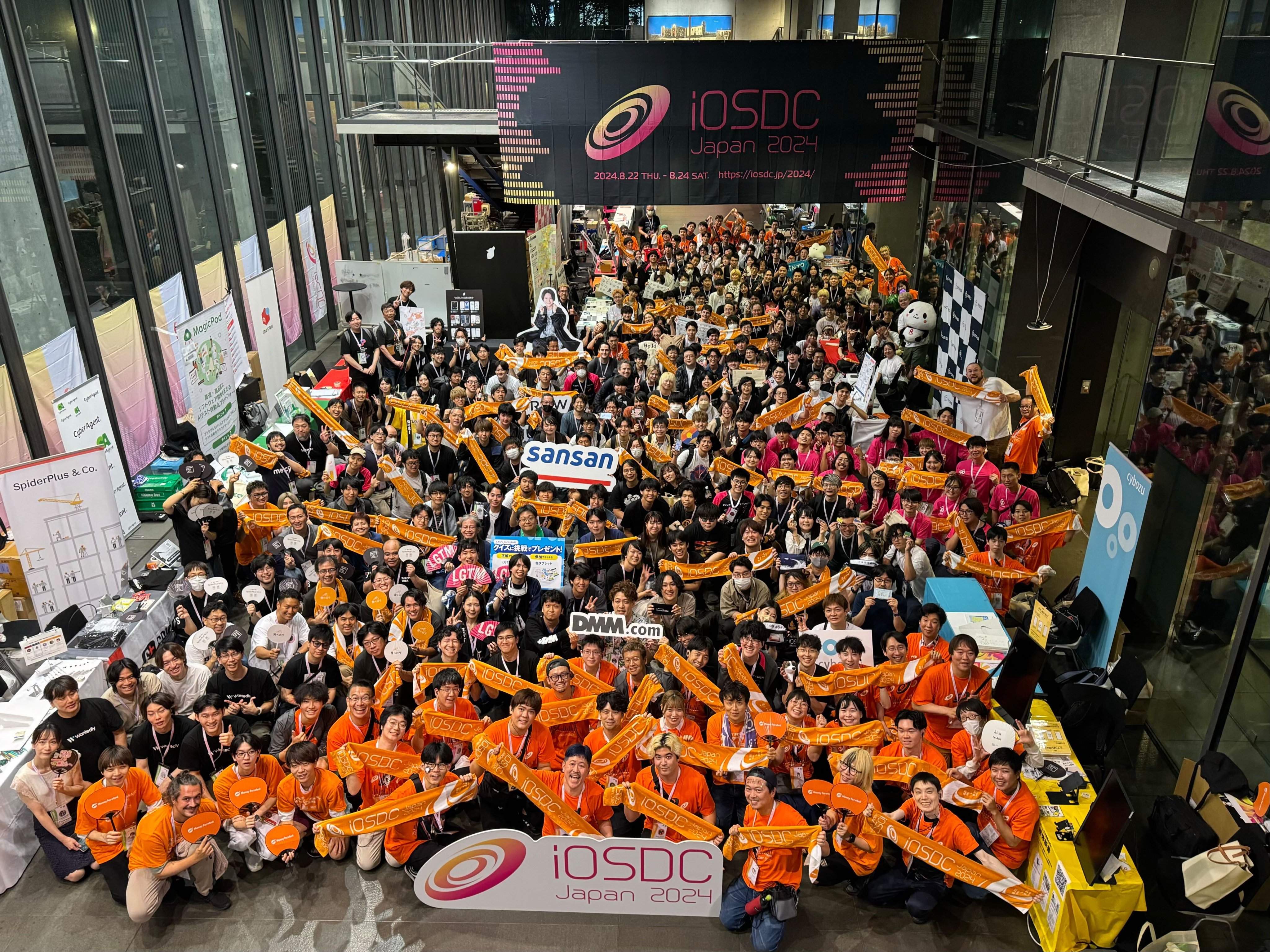
Konnichiwa! I am Felix, and I develop iOS applications at KINTO Technologies. This time, I would like to share my experience at iOSDC, held from August 22nd to 24th (Thursday to Saturday). Continuing from my previous post about trySwift, this was my second time attending an iOS conference. This time, we participated as a sponsor and hosted our own booth!
KINTO Booth


Our booth was decked out in KINTO blue, and as you can see, even the happi coats (traditional Japanese straight-sleeved coats) matched the theme! We hosted a coding challenge where participants had to read through some real project code and stamp the corresponding question numbers onto the code.
For our booth giveaways, we distributed KINTO mascot stickers and cardboard cutouts shaped like iOS devices, which participants could decorate with stickers. Those who took part in the coding challenge received either an eco-bag or a multi-chain as a reward.


It was a great opportunity to engage with attendees, hear their thoughts on KINTO Technologies, and gather valuable feedback on our projects. The conversations provided fresh insights into how our products are perceived and offered helpful guidance for future improvements.
Other Booths
There were many interesting and educational booths from other companies that caught my attention, and I'd like to highlight a few that stood out:
Sansan

Sansan’s booth was intriguing because it showcased their technology stack, allowing guests to react to various tools and frameworks.
DeNA


DeNA’s booth had a particularly fun activity where participants solved a crossword puzzle by both reading code and looking at a map.
Bitkey

Although you needed a test device and a MacBook to implement their beacon app, it was fun trying to develop the test app and find the person carrying the beacon.
Glassfiber

Glassfiber had a quiz that attracted a lot of people, offering both fun and educational content.
Presentations
I attended several sessions and would like to highlight the two that impressed me the most:
Modern In-App Purchasing with StoreKit 2
First, I would like to talk about StoreKit 2 and its modern usage. As I haven't worked with StoreKit yet, I found the session insightful. It focused on the introduction, implementation, and testing of StoreKit 2, with a detailed comparison to StoreKit 1. The presentation covered key areas like simplifying asynchronous processing with async/await, streamlining receipt validation, and testing using sandbox environments, TestFlight, and StoreKitTest. This was highly informative for anyone looking to integrate in-app purchases into their apps. One interesting point I learned was that StoreKit doesn't directly support scenarios where a customer makes a payment but doesn't receive their purchased item, which was surprising to me.
StoreKit 2によるモダンなアプリ内課金
This session explains StoreKit 2 implementation and testing, focusing on improvements and simplifying in-app purchases.
How does GPS find your location?
Another session I found interesting was about how mobile devices receive GPS signals and compute their location. It explained how Core Location uses a combination of GPS, Wi-Fi, and cellular signals for accurate positioning. While the basic GPS principle is triangulation with satellites, the talk also highlighted the complex engineering behind receiving weak signals over vast distances and how smartphones leverage network data for quick, precise results. I did not really know much related to this topic so I found it enlightening.
GPSでどのようにして現在地が分かるのか
The video explores how GPS and network data enable smartphones to quickly and accurately determine location.
Conclusion
Overall, iOSDC 2024 was a fantastic experience. It was not only an opportunity to learn from insightful sessions but also a chance to engage with the broader iOS developer community. Hosting the KINTO booth allowed me to interact with many talented individuals, hear their feedback, and showcase our work in a meaningful way. The presentations I attended, particularly those on StoreKit 2 and GPS technology, provided me with actionable insights that I can directly apply to KINTO’s ongoing projects. For example, the async/await improvements in StoreKit 2 will greatly streamline our in-app purchase implementation, making the process more efficient and user-friendly. Similarly, the advanced use of GPS and network triangulation will help us enhance location-based services in our apps, leading to more accurate and faster results for users. I’m excited to integrate these learnings into our development process and continue growing as a developer. Thank you for reading!

関連記事 | Related Posts




We are hiring!
【オープンポジション】「気になる!」方はまずはこちらからご応募ください。/東京・名古屋・大阪・福岡
業務内容国内外のKINTOサービスや、トヨタグループの金融、モビリティサービスの内製開発組織である同社にて、ご経験・ご志向性に応じて配属を決定し、ご活躍いただきます。
【Java/Python】事業や組織の成長に携わるプロダクトエンジニア(AWS環境)/KINTO CXシステム開発G/東京・名古屋
KINTO CXシステム開発グループについてTOYOTAのクルマのサブスクリプションサービスである『 KINTO 』を中心とした国内向けサービスのプロジェクト立ち上げから運用保守に至るまでの運営管理を行っています。大手EC、SIer、ベンチャー、Webサービス企業など、さまざまなスペシャリストが集まり、KINTOサービスを開発しています。
Follow Us



KINTOテクノロジーズの最新情報をSNSで発信中!イベント・テックブログ更新情報もお届けします。